An analysis of heart rate, electrodermal activity, skin temperature and movement recorded with an Empatica E4 during acute psychological stress, aerobic cycling and anaerobic sprints. Physiology comes first, every result is computed per participant, and machine learning is only evaluated on people it has never seen.
An accelerometer tells us that someone is moving. Heart rate, electrodermal activity and skin temperature tell us how the body is responding. The main question: how do wearable physiological signals differ between aerobic exercise, anaerobic exercise and acute stress? A follow-up runs through the whole project: how much of any difference is physiology, and how much is simply movement?
3-axis accelerometer (32 Hz). Context: pedalling rhythm, sprint bursts, stillness.
Wrist PPG (64 Hz) → heart rate and beat intervals: load, sympathovagal balance, HRV.
Electrodermal activity (sympathetic sudomotor drive, sweating) and skin temperature (peripheral perfusion).
PhysioNet Wearable Device Dataset from Induced Stress and Structured Exercise Sessions (v1.0.1; Hongn et al., Scientific Data 2025). 30 participants completed all three protocols, so most comparisons are within the same person. Every one of the 707 files was verified against the official checksums.
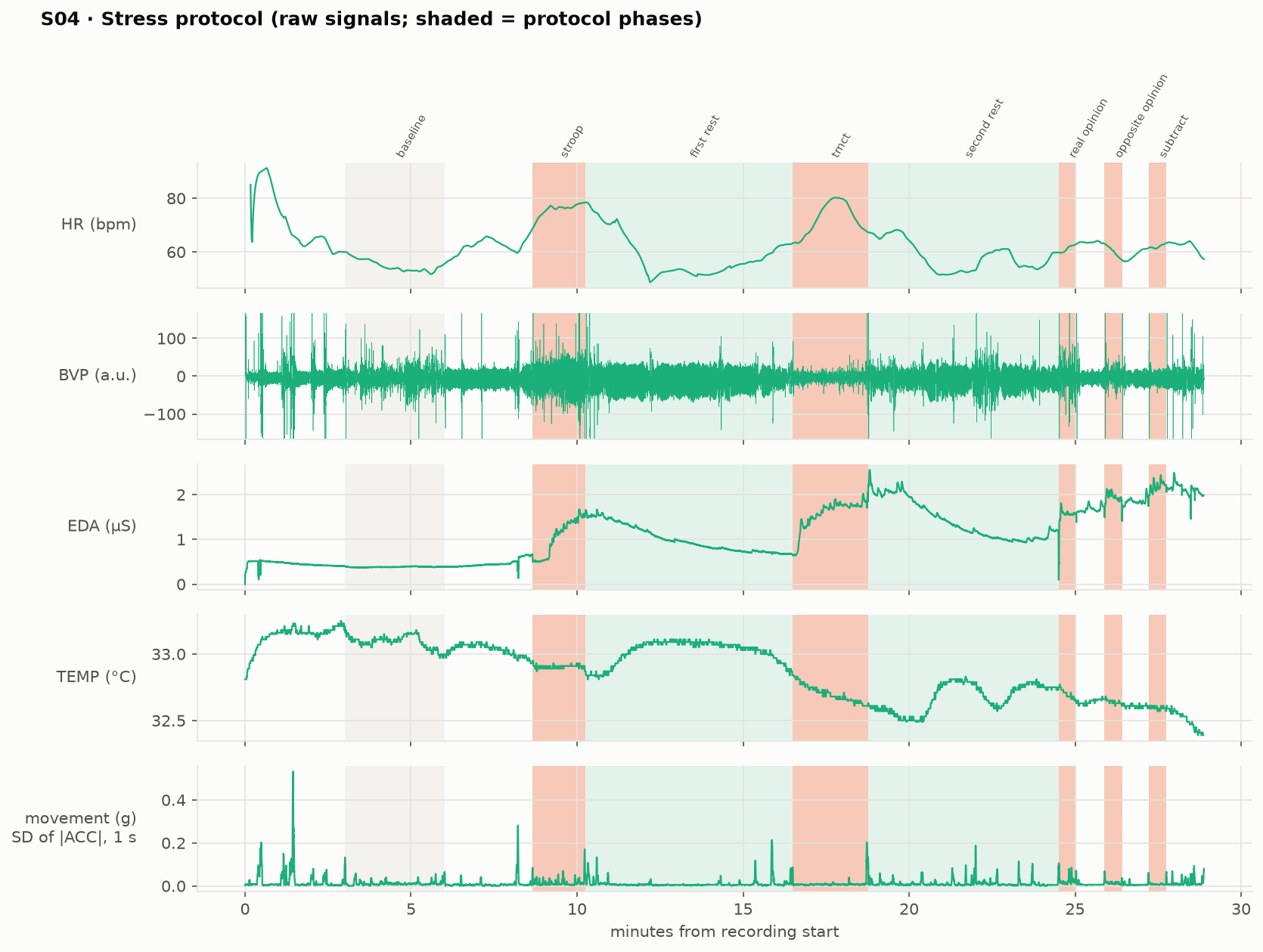
Seated. Baseline → Stroop (v1) → Trier Mental Challenge Test (timed arithmetic with aversive noise) → rest → opinion, opposite opinion and serial-subtraction tasks.
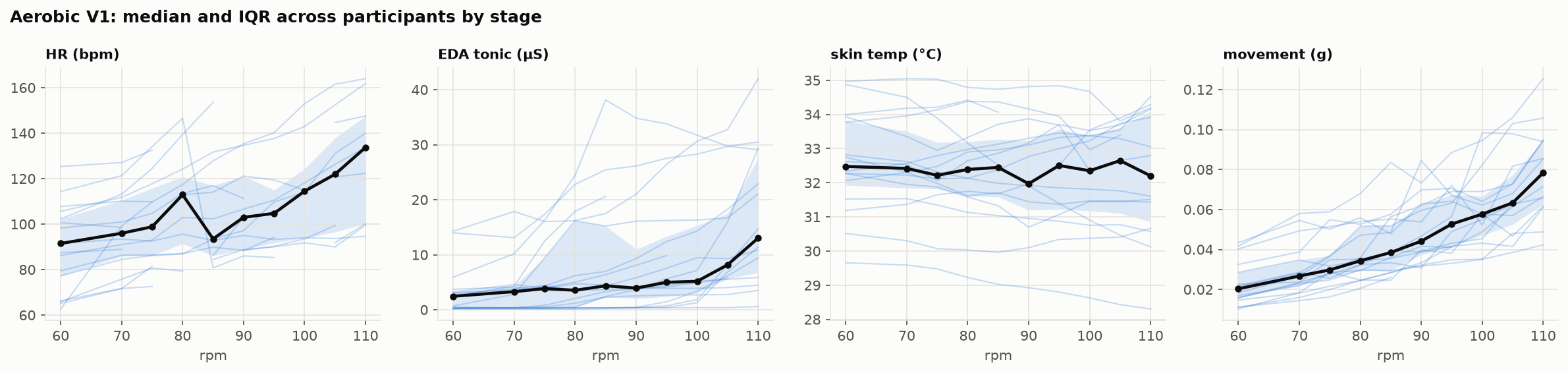
Incremental stationary cycling, 60 → 110 rpm with rising resistance (individual sessions), or a 70–95 rpm group spinning class.
Wingate-style: 3–4 all-out sprints of 30–45 s, each followed by ~4 min of unloaded pedalling.
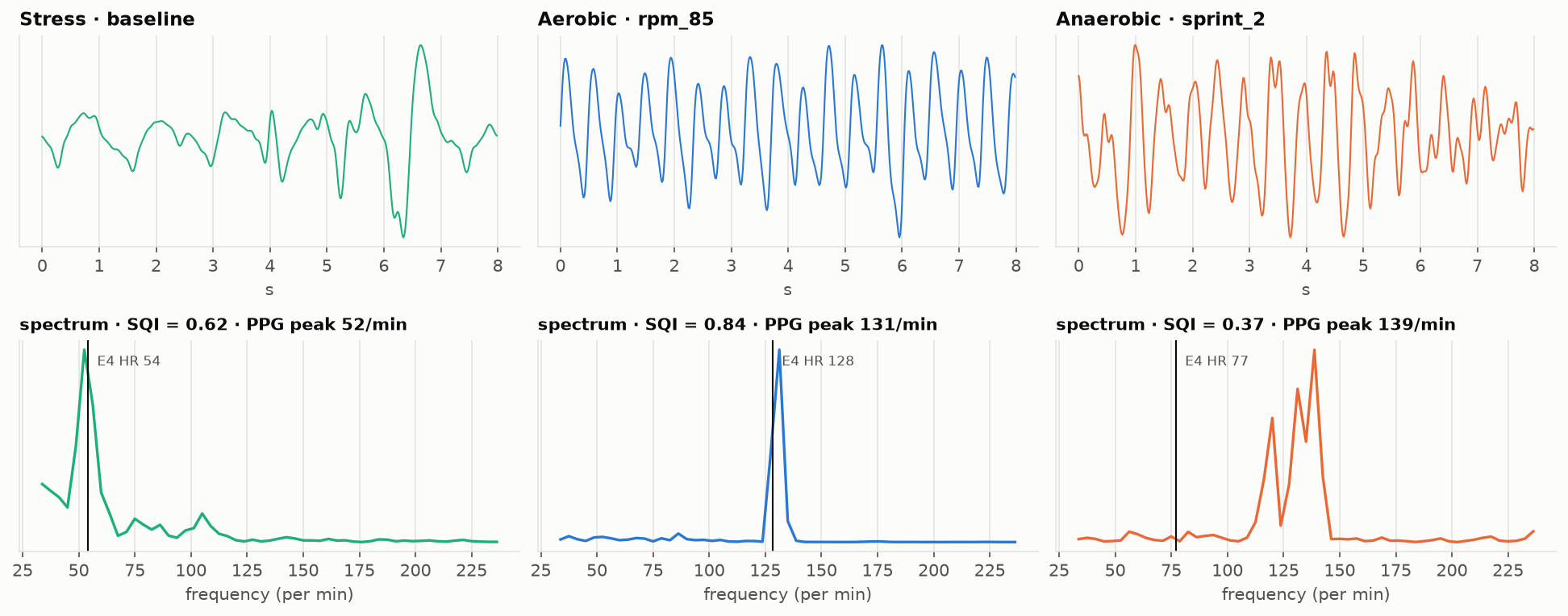
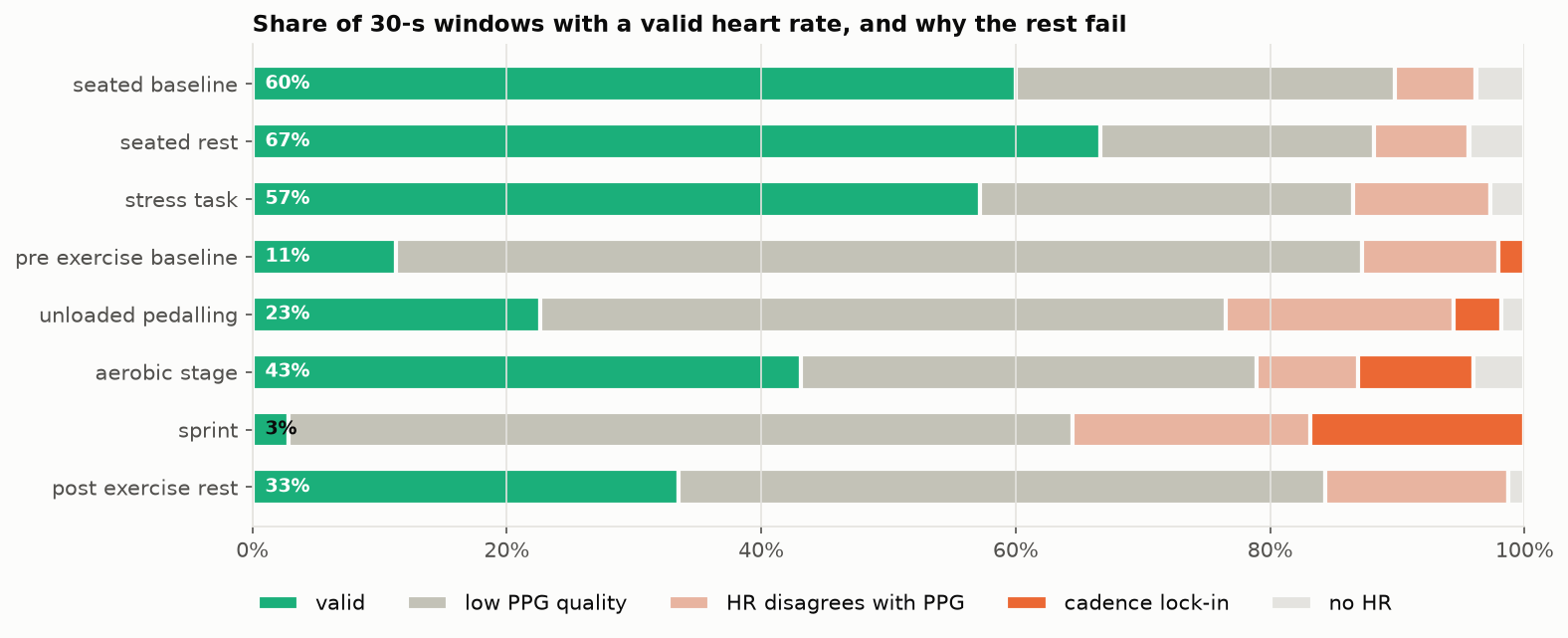
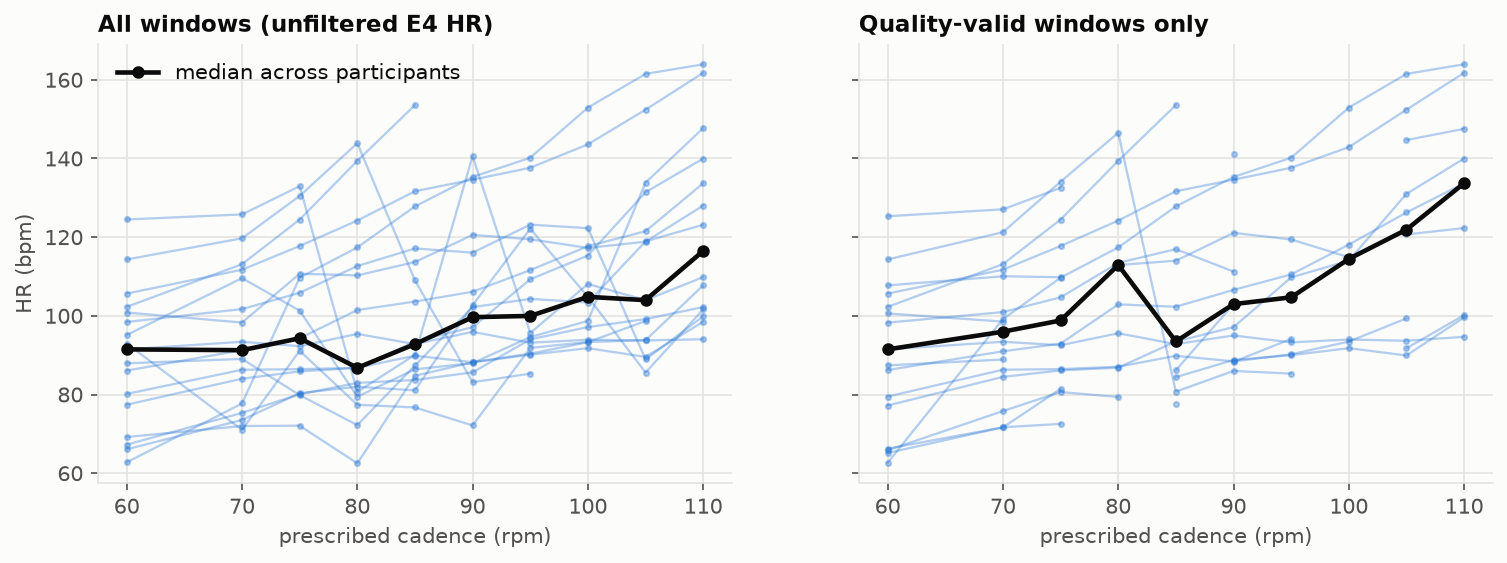
Empatica's heart rate was often physiologically implausible during cycling: flat, erratic, or locked onto the pedalling rhythm. Every 30-s window got a quality verdict per signal. The rules use signal properties only: PPG spectral quality, agreement between independent HR estimates, and cadence lock-in detected with the accelerometer. They never use the expected result.
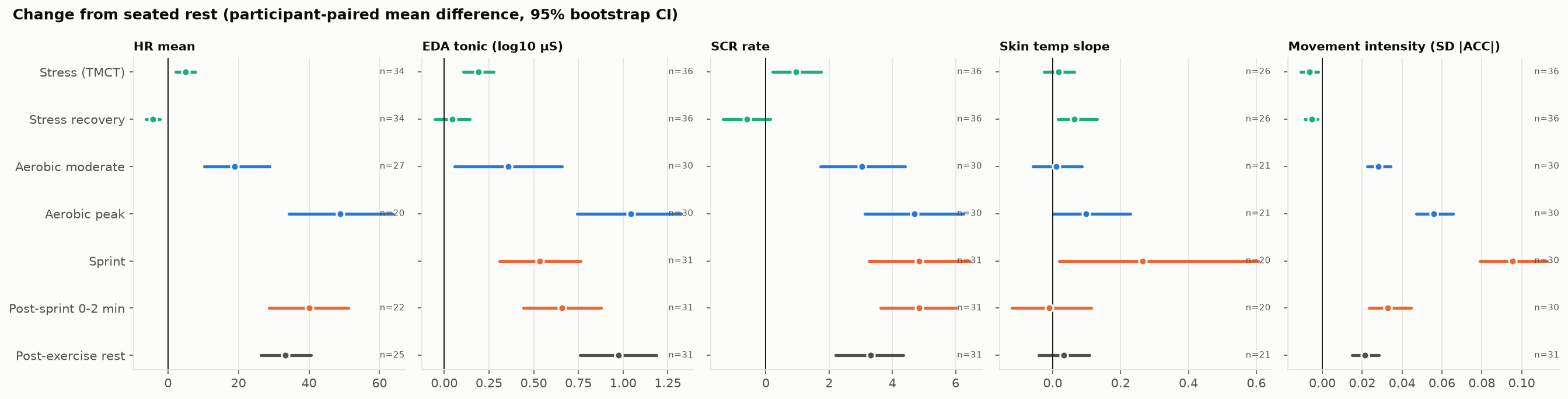
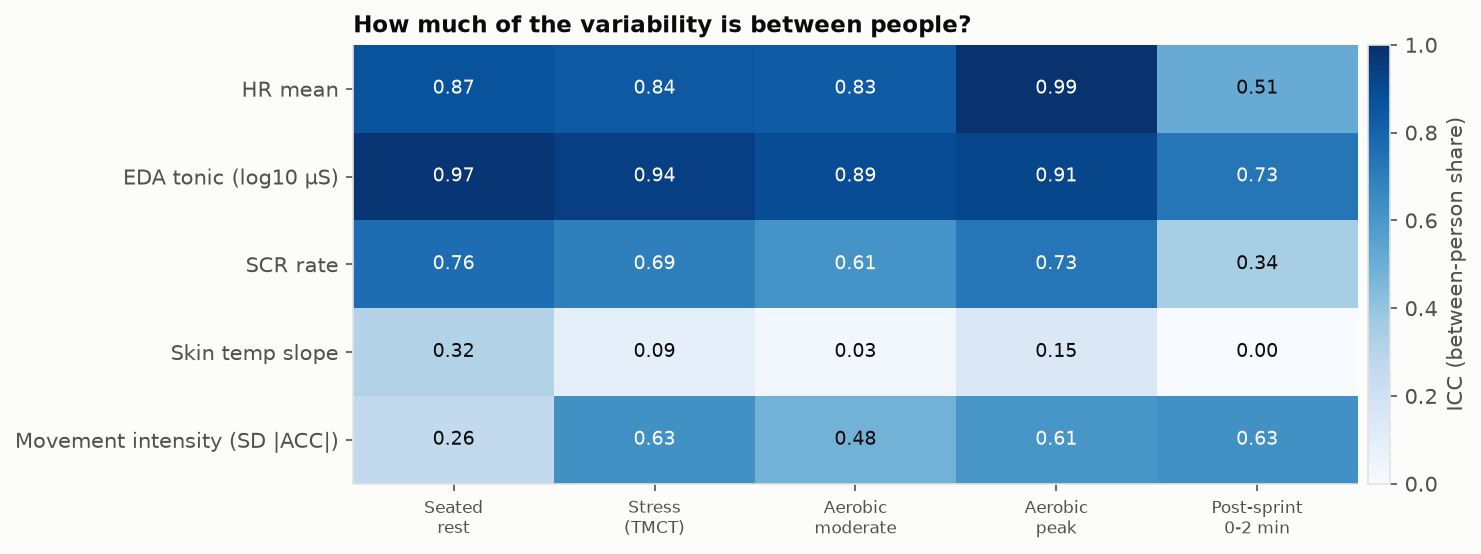
All numbers are participant-level: windows are averaged within each person first, and the differences are paired within person, with bootstrap 95% CIs.
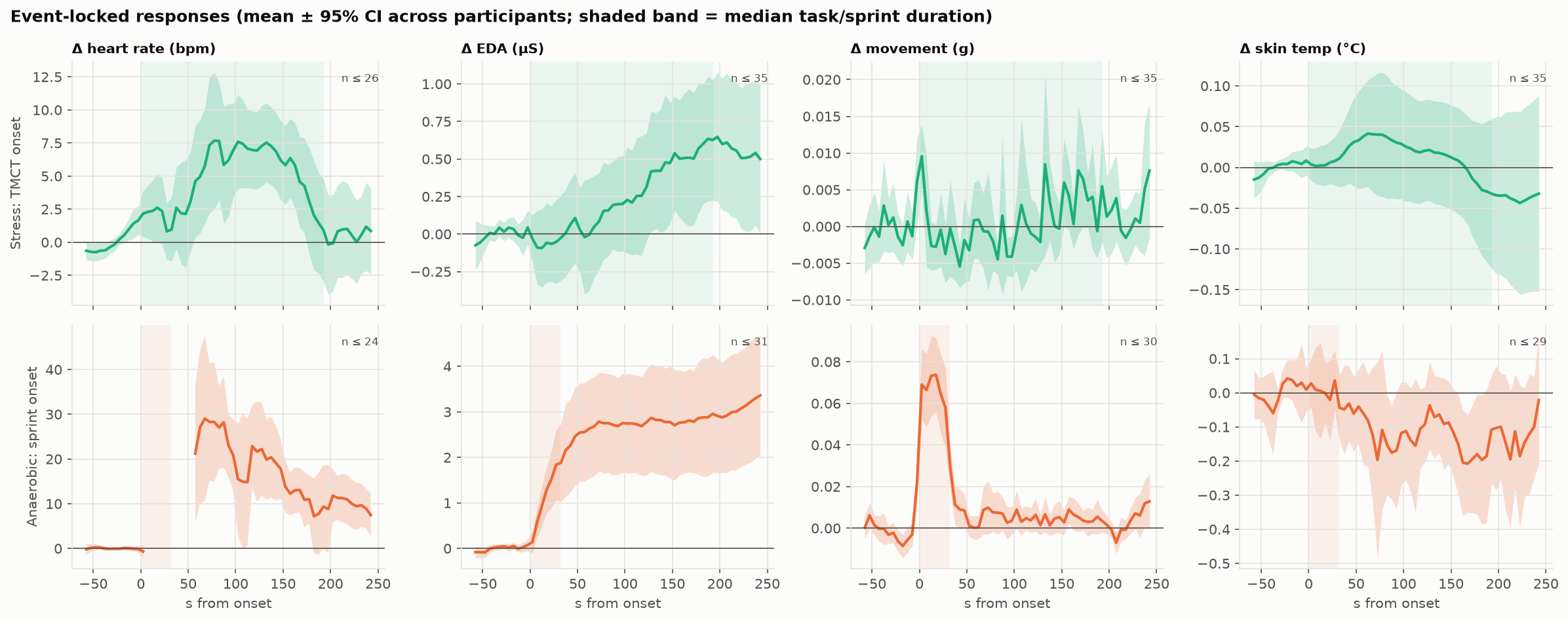
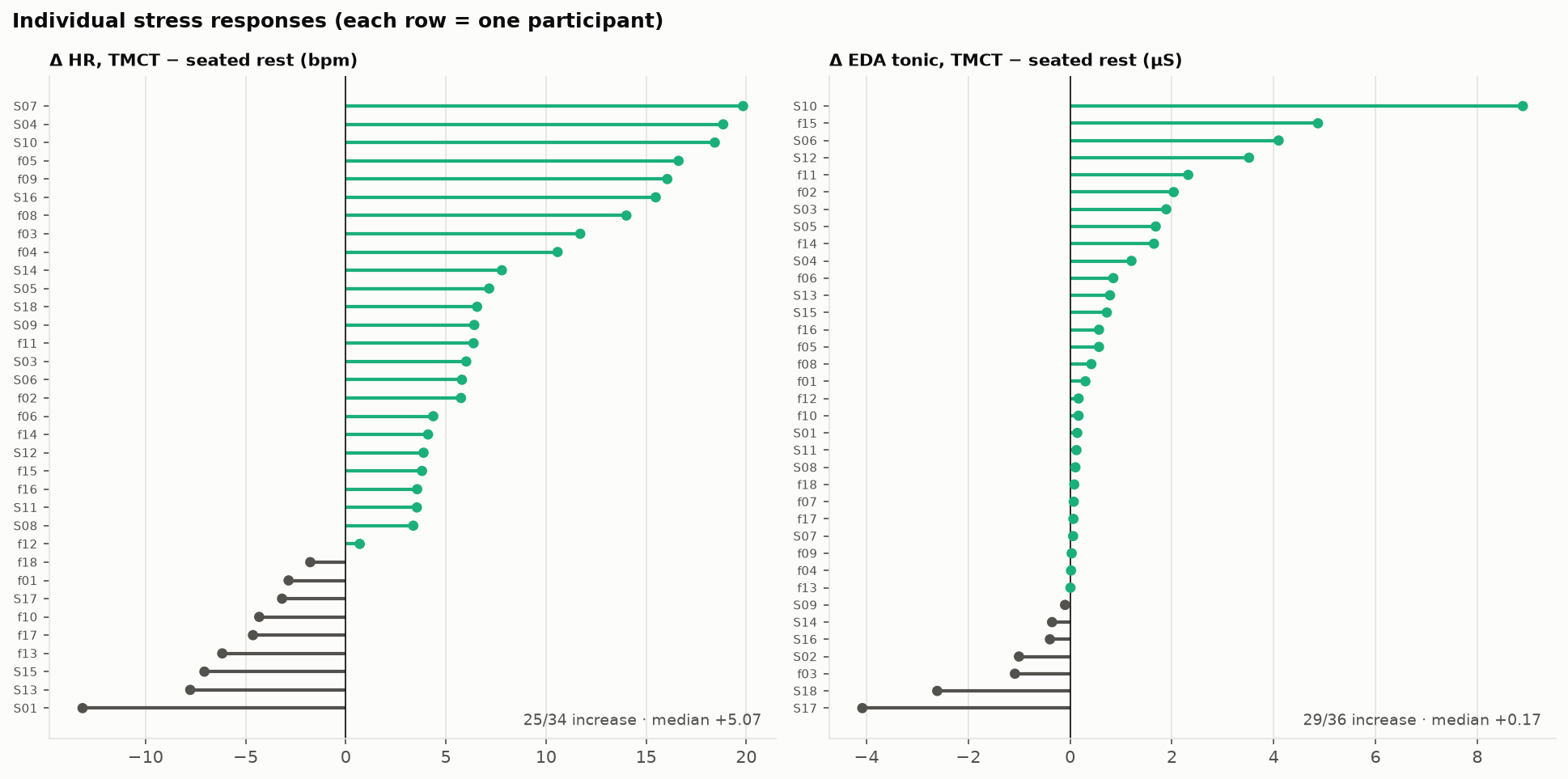
Heart-rate response to the mental-stress task (95% CI 2.2–7.8, same day, n = 34). HR then drops below the starting baseline during recovery, which suggests the baseline itself held anticipatory arousal.
Wrist movement decreases during stress. The physiological response happens with the body stiller than at rest, so it cannot be a movement artefact.
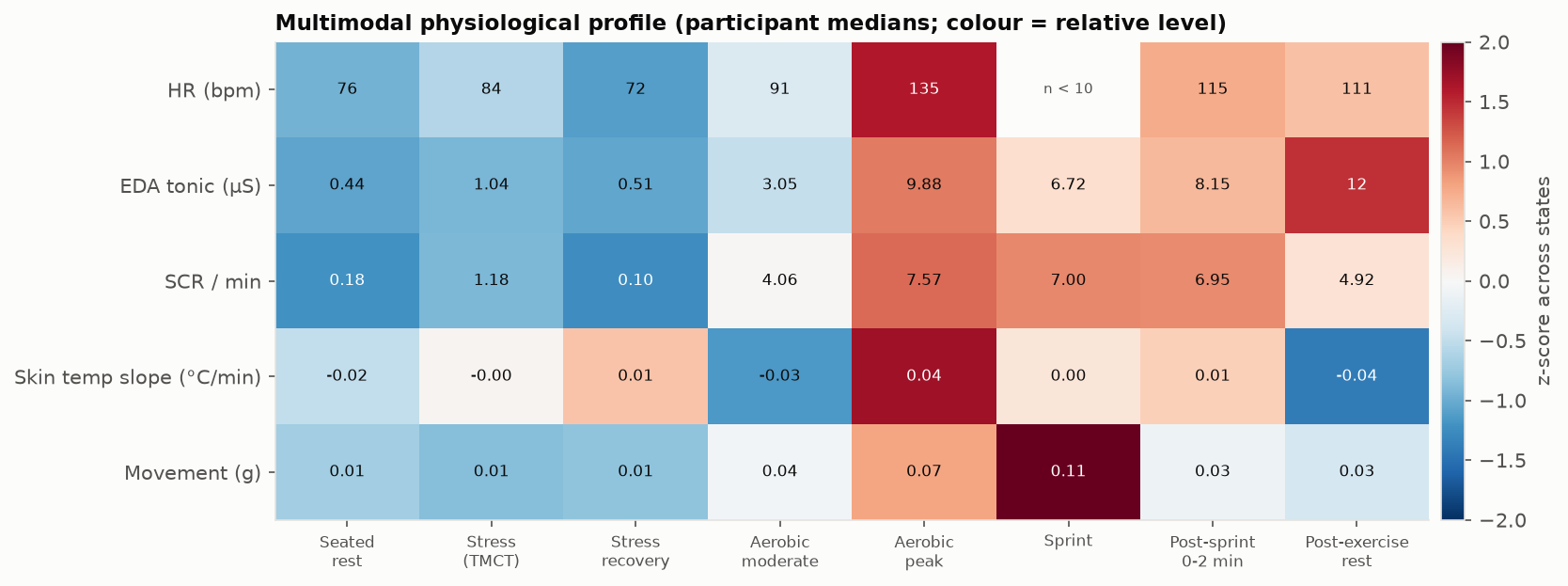
At the aerobic peak, about 10× the stress response. EDA is ~11× its resting level, against ~1.6× under stress.
After a sprint, HR keeps climbing. The cardiovascular response lags the mechanical effort, and valid HR from the wrist only returns about a minute after the sprint.
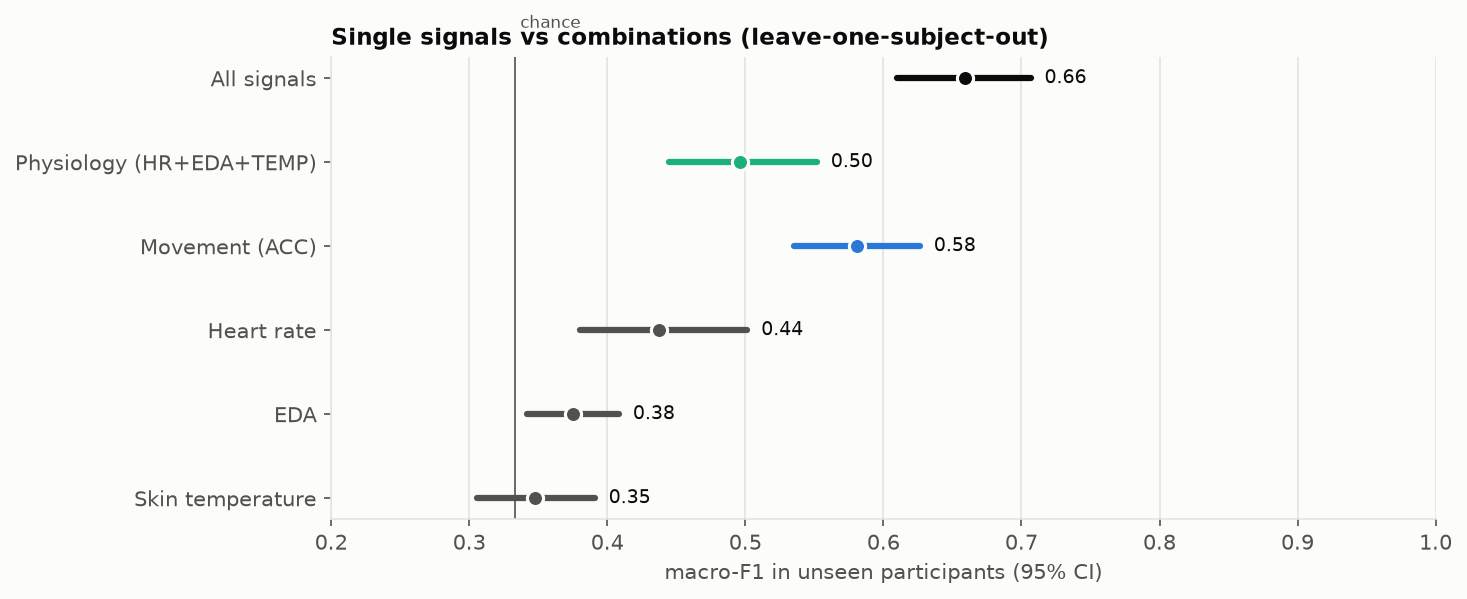
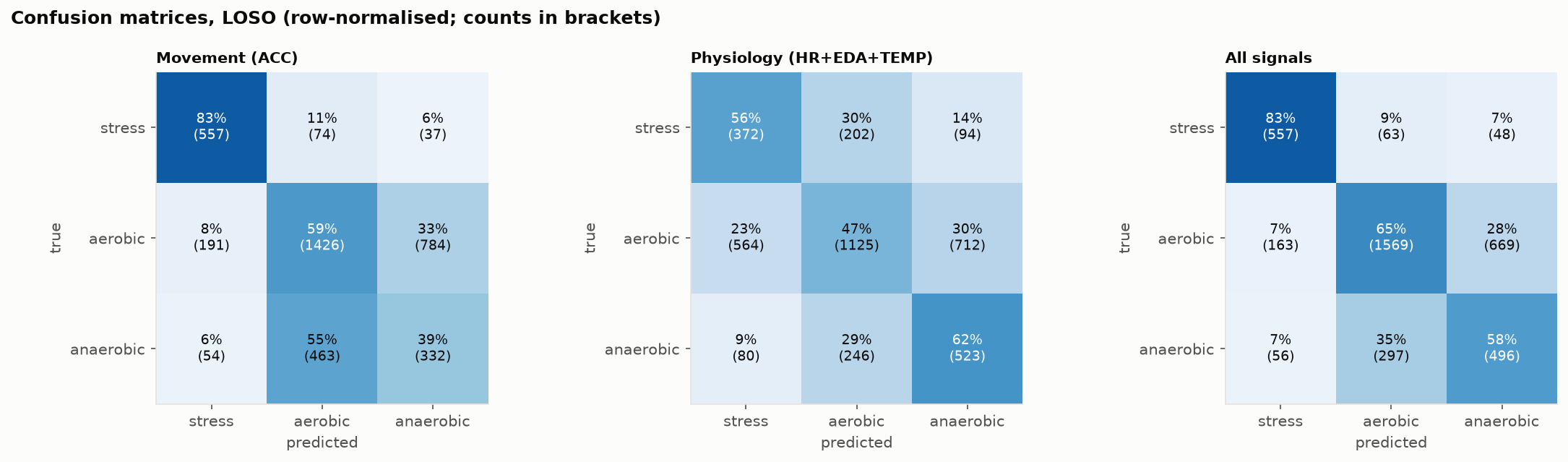
Classes: stress tasks, aerobic stages, and sprints plus their first 2 min of recovery. Validation: leave-one-subject-out. Metrics: macro-F1 and balanced accuracy, with CIs from resampling participants.
| Result | macro-F1 | What it means |
|---|---|---|
| Random window split (leaky) | 0.83 | Same people in train and test: the model recognises individuals |
| Leave-one-subject-out, all signals | 0.66 (0.61–0.71) | Honest estimate for a new person |
| Movement only | 0.58 | Best single modality: seated vs pedalling |
| Physiology only (HR + EDA + temperature) | 0.50 | Above chance (0.33), weaker than movement |
| Movement + "HR missing" flag | 0.64 | Nearly all the gain: the PPG failing during sprints is itself a cue |
| Stress vs seated rest, physiology only | 0.65 (0.60–0.70) | Where movement can't help, physiology (EDA first) does |
36 young, healthy adults. Cohort is confounded with sex, age, training status and protocol version (v1: 18 men; v2: 17 women + 1 man).
No ECG, power output, VO₂ or lactate. "Aerobic" and "anaerobic" are protocol labels, not verified metabolic states.
HR is unmeasurable during sprints and often corrupted while pedalling. HRV is only defensible while seated.
The resting reference is on another day. The 30-s stress tasks are short relative to EDA and HRV dynamics.
Nothing here supports clinical inference or diagnosis.